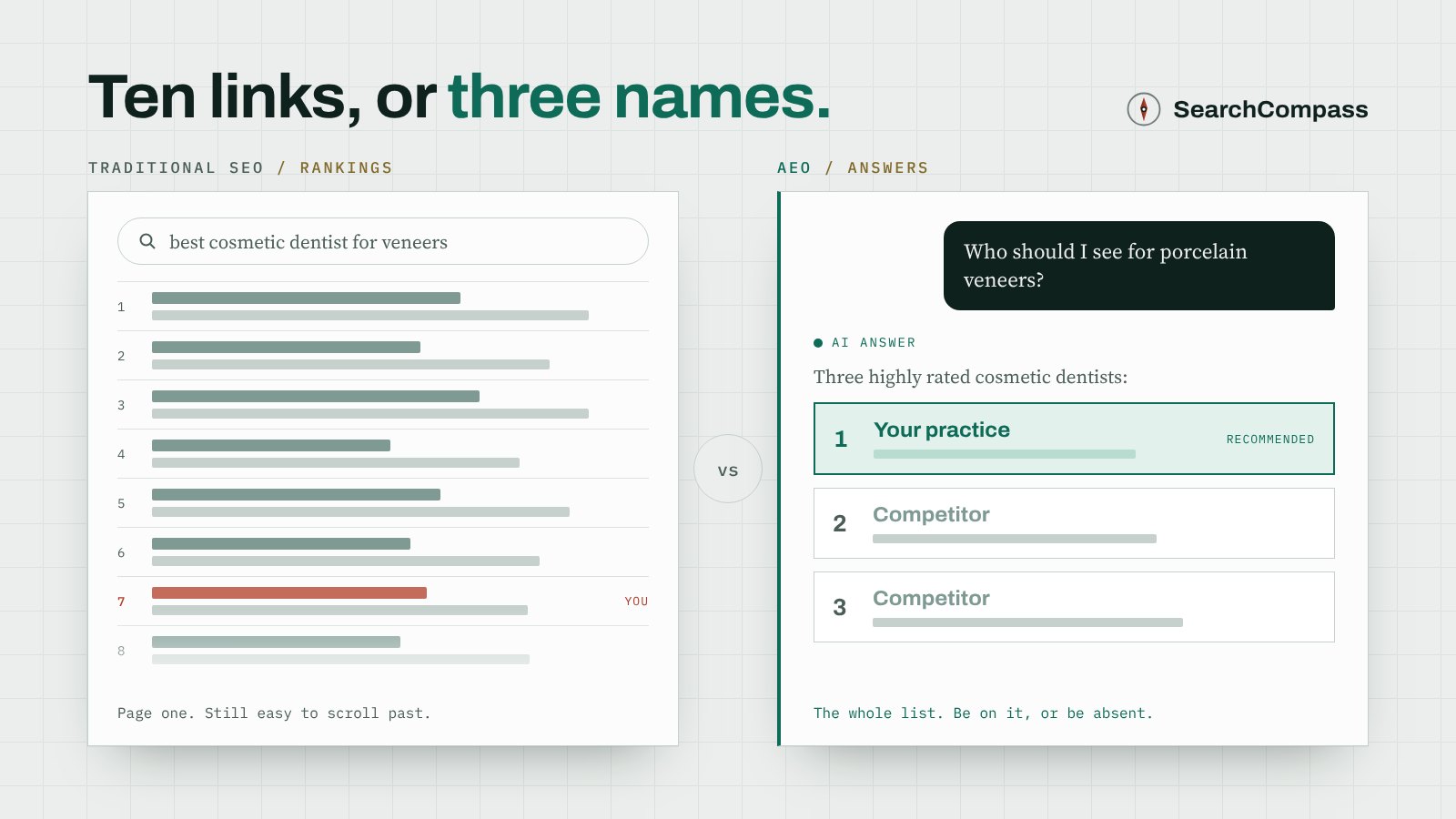
Traditional SEO optimizes your website to rank in Google. Answer engine optimization (AEO) optimizes your business to be named inside the answers ChatGPT, Gemini, Perplexity and Google's AI Overviews give. For high-ticket businesses, AEO is now critical: in a 2026 study by ListedInAI, 86% of local businesses never appeared in a single AI recommendation, and those were the most-reviewed businesses in their markets. You need both strategies to win the clients who ask AI first.
What is the difference between AEO and SEO?
Search engine optimization (SEO) improves a website's visibility in traditional search results. Answer engine optimization (AEO) works to get your business included in AI-generated answers and featured snippets. The two disciplines do different jobs, and most businesses need both.
SEO earns authority through relevant content and a technically sound site. It builds the foundation that makes discovery possible. AEO focuses on being included in the answers AI engines put together on the spot. One builds the foundation. The other earns the spotlight.
For a high-ticket business, the distinction carries real financial weight. A prospect asking ChatGPT or Gemini for a recommendation sees two or three names, not a page of ten. If your business is not in that answer, the inquiry never reaches you. SEO alone cannot get you there.
How does AEO differ from traditional SEO in practice?
Traditional SEO targets ranking positions on a search results page. AEO targets the answer box, the voice response and the AI summary. SEO brings people to your site. AEO helps you appear in the answer they see first. A business that ignores AEO can lose the recommendation before the prospect ever clicks a link.
The two build on each other. AEO depends on the authority signals SEO creates. Without those signals, AI engines lack the confidence to cite your content. With them, your business becomes a source the engine trusts.
Which approach matters more for a high-ticket service business?
Both matter, but the urgency tilts toward AEO. A prospect looking for a specialized service rarely looks past the names an AI assistant recommends. Missing from that short list means losing the client before the conversation begins.
SearchCompass was built for exactly this gap: a nationwide managed findability and AI search optimization service for established, owner-led businesses. It combines the technical foundation of SEO with the answer-level work of AEO, so your business shows up where high-intent buyers look first.
| Criterion | Traditional SEO agency | AEO agency |
|---|---|---|
| Primary goal | Rank in traditional search results | Appear inside AI-generated answers and featured snippets |
| Visibility type | A link on a results page | A direct answer in an AI summary or voice response |
| Technical focus | Authority, content, site structure | Structured data, entity clarity, answer formatting |
| Outcome for high-ticket businesses | Traffic to the website | A place among the two or three names a prospect sees first |
Why does AEO matter for high-ticket businesses?
High-ticket businesses can lose clients before the first phone call. AEO determines whether your name appears in the AI-generated answer a prospect sees. That invisibility is expensive when a single client relationship is worth thousands of dollars.
The numbers explain the urgency. When Google shows an AI summary, users click a traditional search result on just 8% of visits, compared with 15% when there is no summary, according to Pew Research Center. Users were also more likely to end their browsing session entirely after seeing an AI summary. For a high-ticket practice, those numbers translate into inquiries that never arrive.
How does AEO change the client acquisition path for high-ticket services?
A prospect asking an AI assistant for a recommendation gets two or three names with a reason for each. No list of ten. No scrolling. If your business is missing from that answer, the conversation ends before it begins. SearchCompass helps professional service providers turn AI searches into clients by working to get them into those recommendations.
What separates an AEO agency from a traditional SEO agency?
Traditional SEO agencies optimize for rankings on a search results page. An AEO-focused approach optimizes for inclusion in the answer itself. The difference matters because click behavior has changed. A page-one ranking is worth less when a growing share of searches end without a click. For a high-ticket business, that difference determines whether you are recommended or overlooked.
How does managed findability differ from directory management?
Managed findability covers eight distinct discovery channels. Standard directory management covers one. That gap determines whether a high-ticket business appears in the AI recommendations that now shape client decisions, or stays invisible to the people asking for recommendations.
SearchCompass works across eight directions: AI answers, answer engines, organic search, business profile and maps, reviews, content, press and citations, and structured data. Standard local directory management addresses only the business profile and maps. The difference is not incremental. It is structural.
What does a standard directory service actually cover?
A directory management service claims and updates your business listings. It keeps your name, address and phone number consistent across platforms. That work matters for map visibility. It does little for AI answers, content authority or structured data, which leaves most discovery channels untouched.
Why do AI answers require more than directory accuracy?
Answer engines do not rely on directory listings alone. They pull information together from many sources, favoring content they can interpret, trust and summarize. Accurate listings help, but on their own they rarely give an AI system enough to cite a business by name.
SearchCompass operates as a managed service: our team does the work, and you approve what goes out under your name. That work spans all eight directions, not just one.
| Capability | Standard directory management | SearchCompass managed findability |
|---|---|---|
| Business profile and maps | Yes | Yes |
| AI answer optimization | No | Yes |
| Answer engine visibility | No | Yes |
| Organic search | No | Yes |
| Review strategy | No | Yes |
| Content authority | No | Yes |
| Press and citations | No | Yes |
| Structured data | No | Yes |
| Managed execution | Varies | Full service, with your approval |
A business that only manages directories leaves seven channels unaddressed, and those are the channels AI recommendations draw on. For high-ticket trades and clinical practices, the cost of that gap is not theoretical. It shows up as inquiries that never arrive.
What criteria should you use to compare AEO and SEO?
The right criteria separate real findability from vanity metrics. A high-ticket business needs visibility where decisions happen, not just where people browse. Three things matter most: what each discipline optimizes for, how each measures success, and which one reaches the buyer before a competitor's name enters the conversation.
What does each approach actually optimize?
Traditional SEO drives long-form content, rankings and organic traffic, and it builds the technical foundation everything else depends on. AEO focuses on being named in the answer itself. One earns the click. The other earns the answer that appears before any click happens.
For a high-ticket clinical practice or professional service, that distinction carries weight. A prospective patient asking an AI assistant for a specialist gets two or three names with reasons. If your practice is not one of them, the inquiry never reaches you.
How do you measure what each delivers?
The metrics diverge sharply. Traditional SEO tracks rankings, click-through rates and organic sessions. AEO tracks whether AI engines recognize your business, how often you are included in AI-generated responses, and how often you are cited as a source.
Specific, verifiable facts matter here. AI systems tend to favor content that gives a clear, concise answer backed by concrete details over vague, padded copy. Your content either supplies what an answer engine needs, or it gets passed over for a source that does.
| Criterion | Traditional SEO | AEO (answer engine optimization) |
|---|---|---|
| Primary goal | Rank in search results | Appear inside AI-generated answers |
| Success metric | Clicks, sessions, rankings | AI recognition, inclusion and citation frequency |
| Content priority | Depth, keyword coverage | Clear answers, specific facts, structured data |
| Technical focus | Crawlability, site speed | Schema markup, entity grounding |
Can one agency deliver both?
Yes. SearchCompass benchmarks findability across six pillars: technical and on-page SEO; domain and competitor search gap; AI search and LLM visibility; backlink authority; local presence and entity grounding; and content and topical authority. That covers both disciplines without treating them as separate engagements.
A free findability check benchmarks where you stand today across all six pillars, scored against three competitors you name.
Why does the distinction matter for high-ticket businesses?
Your next client does not browse. They ask. The assistant answers with a short list. If your business is not on it, you lose the opportunity before you ever knew it existed. That is the cost of optimizing for rankings alone when a large share of searches end without a click.
Which approach delivers more value for your business?
Value depends on what a missed client costs you. For many high-ticket businesses, a handful of new clients a year covers the cost of the program, and in some categories one is enough. That math changes the entire comparison.
Most businesses need both SEO and AEO. A traditional SEO agency optimizes for rankings. An AEO agency optimizes for a place in the answer. The choice comes down to where your next client actually looks.
SearchCompass covers both through managed findability across eight directions. You do not have to choose between SEO and AEO. You get one coordinated program that covers every place a prospective client might find or evaluate your business.
What does the investment actually cost?
| Plan | Monthly | One-time setup |
|---|---|---|
| SearchCompass Essentials | $1,500 | $1,500 |
| SearchCompass Growth | $3,000 | $1,500 |
Both plans are month to month. See SearchCompass pricing for what each includes, and for how many new clients it takes to cover a year in your category.
Many traditional SEO agencies charge monthly retainers in a similar range without touching AI answer engines. You pay for rankings while competitors appear in the AI answer your prospect sees first. That is the loss you never see reported.
How do you choose the right AEO agency for your needs?
Start with one question: does the agency optimize for rankings or for answers? A traditional SEO agency builds rankings and organic traffic. An AEO agency works to put your business inside the answer. For a high-ticket business, the wrong choice means being invisible when a buyer asks ChatGPT or Gemini who to call.
Directory management lists your name in places people search. Managed findability works to make your business one of the two or three names an AI assistant actually recommends. One gets you listed. The other gets you chosen.
What should you verify before hiring an AEO agency?
Start with a baseline. SearchCompass offers a free findability check that benchmarks your business across six pillars against three competitors you name, so you know exactly where you stand before you spend anything. Be wary of any agency that will not show you a baseline before asking for a commitment.
Does experience in your industry matter?
Yes, and it matters more for high-ticket trades and clinical practices. SearchCompass was co-founded by Dave Lee, who has spent more than twenty years in marketing and sales automation working with thousands of small and owner-led businesses, and Ethan Lee, an answer engine optimization specialist. That depth means we understand how owner-led businesses actually win clients, rather than guessing at your market.
| Selection criterion | SearchCompass | Typical traditional SEO agency |
|---|---|---|
| Primary focus | AI answer visibility and search | Search rankings |
| Entry point | Free six-pillar benchmark | Paid audit or proposal |
| Leadership experience | 20+ years, owner-led focus | Varies widely |
| Client model | Established, owner-led businesses | Broad or enterprise |
The free benchmark and the experience behind the service reduce the risk of paying for activity that never produces a single inquiry.
Conclusion
Whether you invest in SEO, AEO or both determines whether your business appears in the answer a buyer receives or stays buried in the rankings. A free findability check gives you the baseline to decide which path delivers the greater return, and takes the guesswork out of the decision.
See where you stand
Our free findability check benchmarks your business across AI answers, search, maps and reviews, scored against three competitors you name. No call required.
Get your free findability check